Since I hosted
the Inferno-themed Blawg Review #35 last December, I've looked forward to making another journey through the legal blogosphere, accompanied by Dante and his guide, the poet Virgil. Thus, Dante's
The Divine Comedy provides the setting for
Blawg Review #86, to which I welcome you.
 Purgatorio
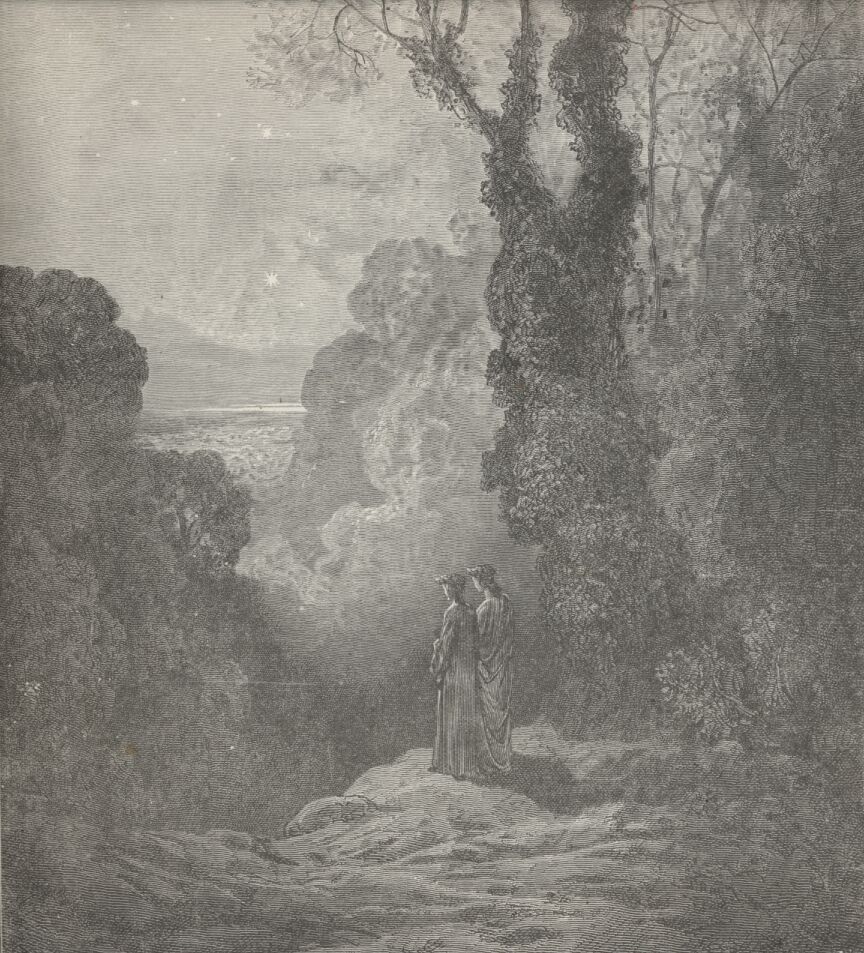
, the second cantica of Dante's masterwork, begins with Dante and Virgil ascending "from the atmosphere of deadly gloom" in the nine circles of Hell to the base of a mountain. This mountain represents Purgatory, the place wherein those souls neither condemned to Hell nor raised to Heaven may be purified of their sins so that they might enter Heaven.
Like the underworld in
Inferno, Dante's Purgatory is a vividly-described and meticulously-detailed place. The mountain is divided into seven terraced levels, each of which corresponds to one of the Seven Deadly Sins. At each of these terraces, sinners face a circumstance particularly suited to their sin; unlike the punishments Dante witnessed in Hell, however, the object in Purgatory is to reform rather than to punish, to transform each of the seven sins into its corresponding virtue so that that soul may ascend, terrace-by-terrace, toward salvation. Like high school football and first-year Federal Civil Procedure, Purgatory is based upon the concept of "no pain, no gain".
Analogous to the "suburb of Hell" in
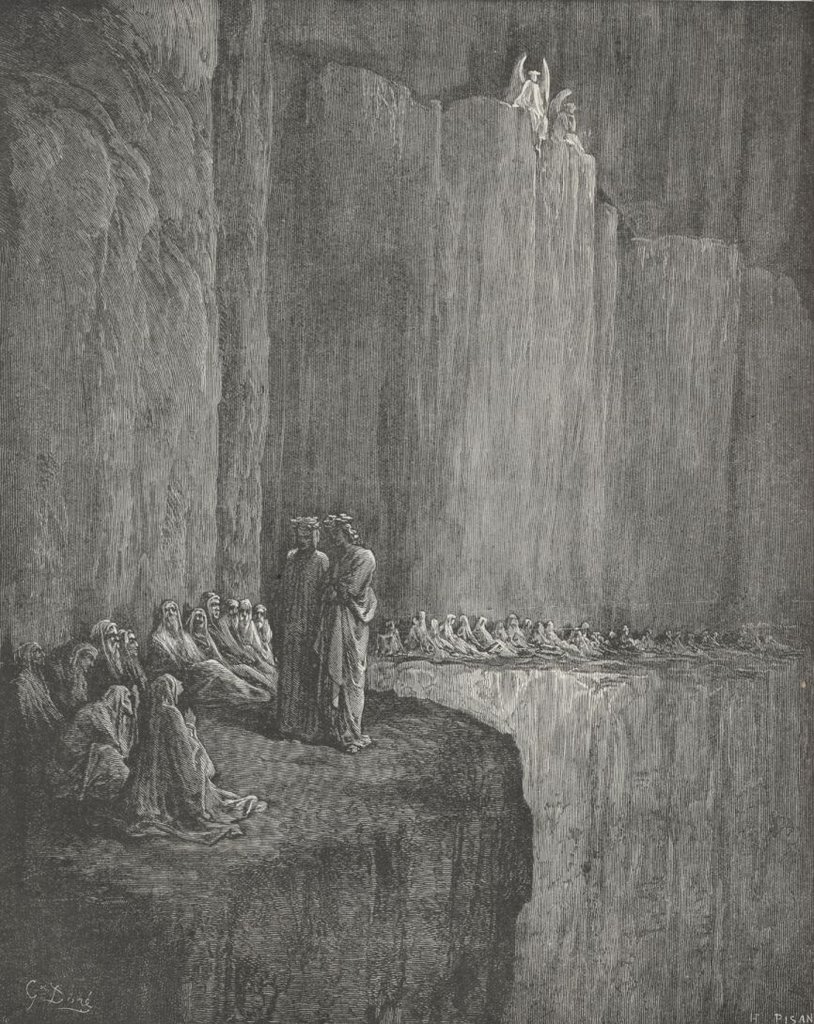
Inferno populated by those "[w]ho lived withouten infamy or praise", there is an ante-Purgatory. Here reside those who were excommunicated, those who were negligent of their salvation and waited until just before their deaths to repent their sins, and those who died violently. Beyond the ante-Purgatory is a "Valley of Rulers"; awaiting an opportunity to begin the ascent of the mountain are King Henry III of England and other monarchs and national leaders for whom the demands of high office were a distraction from spiritual betterment or otherwise diminished their virtues.
One resident is Cato the Younger, the legendarily-incorruptible Roman statesman. It was for his sterling reputation that Cato's name was adopted by the American Colonial authors of the widely-read and influential
Cato's Letters collection of essays, which offered persuasive arguments for broader civil and religious liberty. From the
Cato's Letters essays, and thus indirectly from Cato the Younger, comes the name of the
Cato Institute, a libertarian research organization which supports the work of several prominent legal bloggers, including Randy Barnett, Tyler Cowen, David Kopel, and David Post at the
Volokh Conspiracy blog.
Having passed through these spiritual staging areas, Dante reaches the gate of Purgatory. He prostrates himself at the feet of an angel who sits upon a diamond throne. (And to think that you were satisfied with your Herman Miller Aeron chair!) With his sword, the angel makes seven marks upon Dante's forehead and explains to him that these marks will be removed as he completes his journey through the seven terraces of Purgatory. The angel then produces a pair of keys:
One was of gold, and the other was of silver;
First with the white, and after with the yellow,
Plied he the door, so that I was content.
"Whenever faileth either of these keys
So that it turn not rightly in the lock,"
He said to us, "this entrance doth not open.
More precious one is, but the other needs
More art and intellect ere it unlock,
For it is that which doth the knot unloose.
From Peter I have them; and he bade me err
Rather in opening than in keeping shut,
If people but fall down before my feet."
Then pushed the portals of the sacred door,
Exclaiming: "Enter; but I give you warning
That forth returns whoever looks behind."
And so we begin again . . . .
 Terrace I: Pride
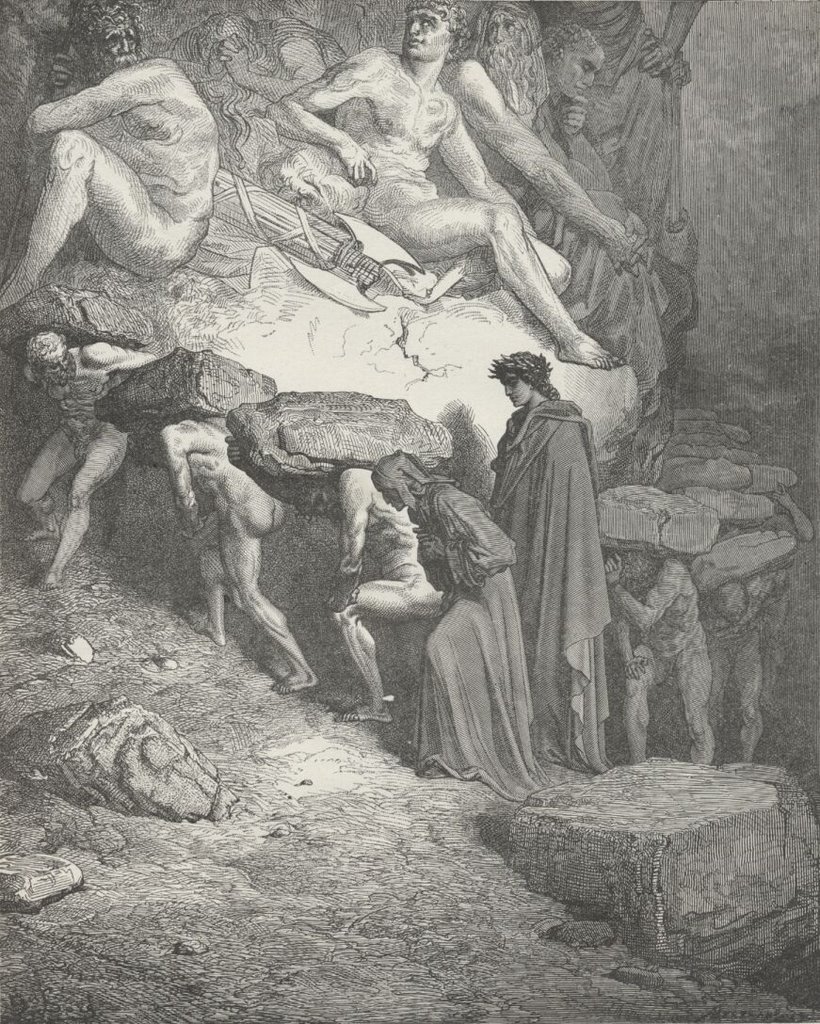
The first terrace of the mountain of Purgatory contains the souls of the prideful, who are burdened with stones which purge them of their arrogance.
Several bloggers can take justifiable pride in their accomplishments this past week, including David Maister of the
Passion, People and Principles blog, who landed a
podcast interview with BusinessWeek Executive Editor John Byrne.
Ken Adams, whose
AdamsDrafting blog quickly found a place on my blogroll, announced that starting early next year he will write a
column in the New York Law Journal on a bi-monthly basis.
A new book by Professor Eric Muller of the
Is That Legal? blog, tentatively-titled
Presumed Traitors: The Hunt for Japanese American Disloyalty in World War II, was
accepted for publication by the Board of Governors of the University of North Carolina Press.
 Terrace II: Envy
In Purgatory's second terrace, the eyes of the Envious are sewn shut with iron thread, to blind them to the temptations around them and aid them in their reformation.
Shertaugh, guest-blogging at
Is That Legal?, noticed a
hint of green in St. Louis Cardinals star Albert Pujols' complexion:
. . . Pujols, runner-up to Ryan Howard in the NL MVP vote, says only players whose teams make the playoffs should be MVP candidates.
While Pujols voices a voting practice to which some members of the Baseball Writers Association of America subscribe, he does overlook this iddy, biddy fact:
Ryan Howard's Philadelphia Phillies won more games than Pujols' Cardinals.
It's not Howard's fault -- as the voters recognized -- that Pujols and the Cardinals were in the worst division in baseball.
Reid Trautz of
Reid My Blog! gave us a list of things we'll envy others having in the coming year in his
2006 Holiday Gift Guide for Lawyers.
 Terrace III: Wrath
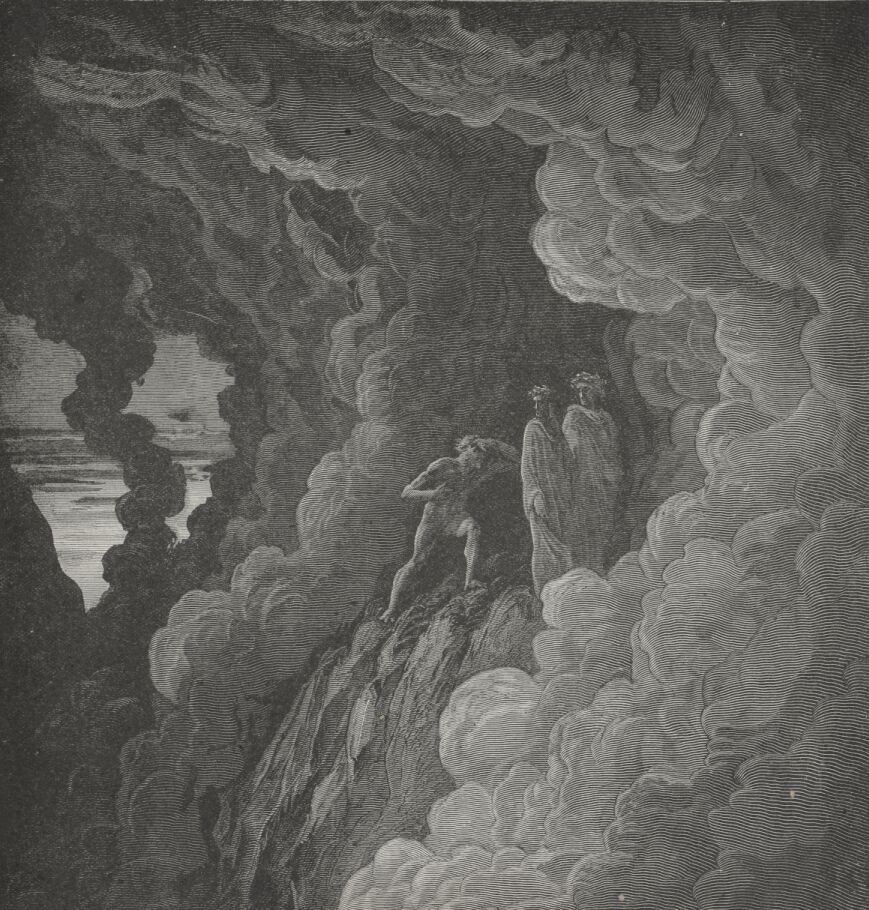
The third terrace contains the souls of those whose wrathful natures blinded their judgment in life; the Wrathful exist in an environment filled with blinding, acrid smoke.
Stephanie WestAllen of the
idealawg blog noted the
havoc caused by wrathful "law firm dragons":
I have found that dragons are typically acting from: 1) fear about their own adequacy, public image or ability to control, 2) power entrancement, or 3) ignorant insensitivity. Regardless of the cause, their long tails can cut a painful swath and their wings can create a damaging gale.
For those of you who toil in dragon-infested firms, WestAllen also offered some useful tips for the care and feeding of those dragons.
Actor (and, it seems, not stand-up comedian) Michael Richards recently displayed a bit more wrath on stage than he did during his
Seinfeld days; despite his subsequent apology on David Letterman's program, he'll atone for that wrath in the Third Terrace this week. Professor Spencer Overton of the
blackprof.com blog wrote that
Richards' apology was important and honest:
Rather than using Richards as a cheap target for our frustration about race, Americans should to use this episode to confront our personal assumptions honestly and question phenomena that many of us accept as normal--such as persisting hypersegregation and the educational achievement gap.
Ernie Svenson of the
Ernie the Attorney blog asked a hypothetical legal question:
"can Richards be held liable to the two men that he initially berated?" Attorney Gloria Allred's daughter, CourtTV blogger Lisa Bloom, noted that, very soon,
that question might not be so hypothetical.
Jen Burke of the
Transcending Gender blog related the tale of a group of wrathful employees and their abused former co-worker; that former co-worker filed suit and
has now prevailed.
Carolyn Elefant of the Law.com
Legal Blog Watch site pointed out a case which demonstrated that
Hell hath no fury like a paralegal overworked. The Law Society of Upper Canada (LSUC) hopes that a paralegal regulated won't be as wrathful. David Giacalone of the
shlep blog reported that the LSUC has been empowered to
regulate the paralegal profession in Ontario:
The Ontario Bar is, apparently, quite pleased with its new role as regulator of legal services provided by paralegals . . . . However, it’s difficult for consumer advocates who have watched the regulatory style of lawyers (and most other professions), and the Bar’s broad dislike of independent paralegals, to be universally sanguine about the regulatory scheme that is being established as a model in Ontario.
It's not so much wrath as disappointment which has caused Professor James Grimmelmann of
The Laboratorium to
stop posting his research to the Social Science Research Network (SSRN) site:
It’s been okay, as far as it goes. The problem, though, is that surprisingly often, SSRN hasn’t gone far enough. Despite being a system supposedly designed to encourage the spread of scholarship, it has made a striking series of decisions that cut against open access.
Others shared Grimmelmann's concerns, including Professor Orin Kerr of the
Volokh Conspiracy blog and Professor Daniel Solove of the
Concurring Opinions blog. Kerr also wondered about the direction in which the site's heading, but said that he's "
not quite ready to pull the plug and stop posting to SSRN"; Solove
suggested that SSRN should focus its efforts on improving access and usability rather than "fun secondary vanity functions like counting downloads".
 Terrace IV: Sloth (Acedia)
In the fourth terrace is a sort of spiritual fun run wherein slothful souls who are still early in their personal redemption are sprinted past by others who have reformed their slothfulness into zeal. The kind of laziness addressed in this terrace is not necessarily physical; rather, it is more often spiritual or intellectual laziness which is the focus here.
Evan Brown of the
InternetCases.com blog noted
an instance of sloppy lawyering on the parts of attorneys for AMF; as a result, the company came out on the short end of an Eighth Circuit decision concerning a pair of its contracts, one oral and one written.
Professor Jack Balkin of the
Balkinization blog thinks that
author Scott Turow was engaging in a bit of wishful thinking when he suggested that Justice Scalia will be a "wild card" vote for civil liberties in the War on Terror:
Would that it were so, but it is not likely. What Turow neglects-- and he is hardly alone-- is that the civil liberties issues raised in the war on terror do not primarily concern construction of the Bill of Rights. Rather, as the Hamdan case suggests, they involve questions of the separation of powers, the scope of Presidential power in wartime, and the President's (and Congress's) authority to regulate aliens.
. . . .
There may be some civil liberties issues in the future in which Scalia joins the liberals. I doubt, however, that many of them will be the key issues in the War on Terror.
Ted Frank of the
PointOfLaw Forum blog thought that there was some lazy analysis in a recent
New York Times article which reported that African-Americans do not rise through the ranks at law firms and make partner in similar percentages as whites. Frank noted that sub-par affirmative action hiring or racism within law firms are less likely causes for the statistical anomaly than
greater opportunities for non-white associates in academia, government, and private industry:
I may be leaving someone out, but the last three African-American associates to leave my last law firm went on to bigger and better things . . . . None are going to be in the small fraction of people ten years out of law school who make partner at the highly-leveraged firm, which is what Sander measures, but none can be said to be lagging unless one incorrectly views law firm work as the pinnacle of the legal profession.
Was it lazy thinking or a cessation of thought which caused airline employees on a Vermont-originating flight to toss a passenger who was publicly breastfeeding her child, as was her right under Vermont law? A spokesperson for the airline initially indicated that it acted because the passenger, Emily Gillette, declined to cover herself with a blanket; the Vermont public breastfeeding law seems to favor Gillette, though, and the airline is backtracking. Gillette declined to cover herself, but most would agree that The Mommy Blawger has her covered, with
three recent posts concerning her case; cynics might suggest, however, that she's just milking Gillette's story for all it's worth.
From Latin, "acedia" translates as an "absence of caring", probably making it an inapt description of Australians during the currently-underway Ashes test cricket series; music publisher EMI thought "copyright infringing" was a more appropriate label. Last week's
Blawg Review host, Peter Black of the
Freedom to Differ blog reported on the legal controversy which arose after a group of Australian cricket supporters
rewrote notable songs to include cricketing themes. Black noted that the case was settled, but that it may still generate some support for ongoing copyright reform efforts.
 Terrace V: Avarice and Prodigality
The fifth terrace is home to the avaricious (the greedy) and the prodigal (spendthrifts), who lie face-down upon the ground to atone for their excessive regard for earthly goods. Here, Dante and Virgil stop to pick up a hitchhiker,
the Roman poet Statius (who has reformed his materialistic nature), as they keep on truckin' toward the Sixth Terrace.
Few fictional characters are so closely associated with greed as is Shylock, the moneylender in Shakespeare's
Gay Boys in Bondage A Merchant of Venice. Professor Nate Oman of the
Concurring Opinions blog determined the
enforceability of Shylock's infamous loan to Ventian merchant Antonio under UCC Article 9 and concluded that "Despite the validity of Shylock's security interest in Antonio's flesh, however, he probably is not entitled to slice Antonio up." Oman's
Concurring Opinions compatriot, Professor Dan Filler, suggested that we avoid the Shylocks of this world altogether and
consider Costco for our discount "dirt nap"-related containment needs.
Professor Stephen Bainbridge,
now appearing in triplicate, considered the
agency implications of the Royal Navy's prize award practices during the eighteenth and nineteenth centuries and noted that, while such prizes might be counterproductive on their own, these should be considered as just one part of a more comprehensive compensation and incentive package during that period of British naval history. It's been said that there's no incentivization like self-incentivization (or at least it's been said now), so Bainbridge debuted
Bain*Mart to move some product this holiday season.
Blogger Nearly Legal had some doubts about the
long-term prospects of legal information in the free spaces of the internet:
The first doubt is how long the 'free' and widespread provision of information and commentary will remain such once its prospective monetisation (beyond google ads) becomes clear. The fusion of old media money and the bloggerati is already becoming clear in some fields (blog to newspaper comment column, blog to book) and, as a hierarchy of posters and commentators in law becomes clear, I would expect something of the same to happen - I can see hirings by big firms based on blog reputation being relatively commonplace a few years down the line, for instance....
Professor Orin Kerr wasn't buying a federal court ruling that designing currency without special accommodations for the visually impaired
denies them meaningful access to the benefits of currency within the meaning of the Rehabilitation Act of 1973. Notwithstanding the professor's skepticism, if the court was correct in its assessment, would providing more meaningful access be more harmful than helpful to to the visually impaired? After all, if you have no meaningful access to the benefits of currency, it's much harder to end up in Purgatory's fifth terrace. Walter Olson of the
Overlawyered blog updated his earlier post on the ruling by noting that
the National Federation of the Blind has issued a press release sharply criticizing both the lawsuit and the decision.
Dan Hull of the
What About Clients? blog offered his
twelve rules of client service last April; this past week, he explained
why those rules may not work:
Because people are selfish, and WAC?'s 12 Rules of True Client Service presupposes that people are not selfish--that you and your staff will put clients before yourselves and All Things other than blood, country, God, a job at the White House or a shot at Parker Posey.
The Wired GC discussed an
interim report from the Committee on Capital Markets Regulation which warned that "excessive regulation and transactional costs are making U.S. companies less competitive in global capital markets."
Whether it's Sarbanes-Oxley or something else, if we stumble, economically-speaking, standing at the head of the line of nations waiting to eat our lunch is China. Dan Harris of the
China Law Blog reported that, borrowing marketing guru Seth Godin's well-known observation,
"Small is the new big in China too." As Harris put it, "Small businesses are booming in China and just as in the West, my sense is that they are oftentimes more dynamic, more nimble, more flexible, and faster growing than the large."
Finally, David Giacalone, this time writing at the
f/k/a [formerly known as] blog, was not pleased by the
misguided attempt of the Texas Bar to stage an appellate haiku contest. Actually, that's stating things far too mildly. Giacalone was so incensed by their "haiku" contest that he set aside both his longstanding antipathy toward theme-based
Blawg Reviews and his disbelief in purgatory to write a lengthy diatribe late last Saturday, just in time for
Blawg Review #86:
What are we to do, then, with this group of Appellate Lawyers who have so misinterpreted and misused the haiku concept, producing haiku abominations aplenty? Fundamentalist or fanatic lovers of “true” haiku might speak in terms of blasphemy and descecration. Imbued with the poetic muse, the f/k/a Gang is, of course, forgiving of human frailities and willing to assume good faith and potential for growth. So, we’re thinking that venial, not mortal, sins have been committed, meriting consignment to a ring of Haiku Purgatorio, and not the Inferno of Hell.
Colin Samuels is, naturally, our expert on Dantenian placement. If we had to pick a level of Haiku Purgatory for our Texan Appellate friends, we might go with Fifth Terrace — which, according to Wikipedia, is one of the levels for “those who sinned by loving good things, but loving them in a disordered way.”
It shall be so! Welcome to the Fifth Terrace, my Texan Appellate friends! Perhaps you would have been happier in
Inferno, where barbeque is more plentiful, but here y'all are and here y'all will stay until you've atoned for your sins against "one-breath" poetry.
 Terrace VI: Gluttony
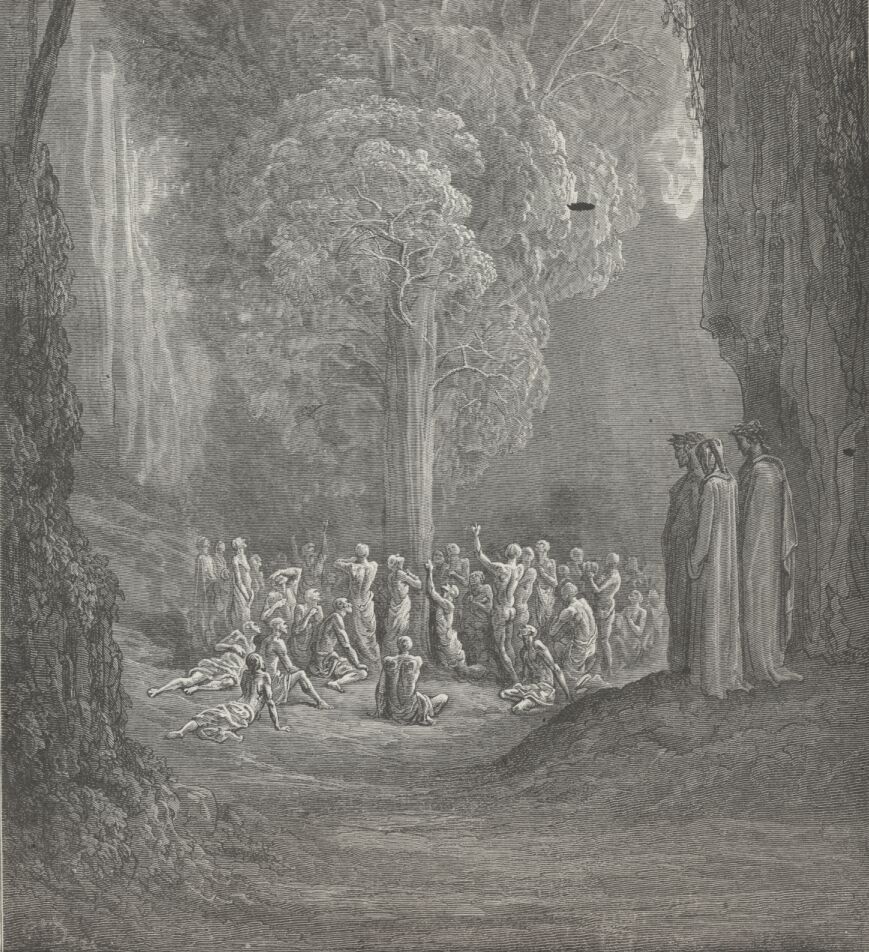
In the sixth terrace, gluttons must abstain from tasting the fruit of a bountiful tree and from drinking from a stream of cool water.
Gluttons of the world unite (and form a study group)! Professor Ann Althouse reported that many of the same fine folks in academia who championed women's (or womyn's) studies, queer studies, disability studies, and ethnic studies as recognized disciplines
are now backing "Fat Studies". In a follow-on post prompted by a
post by Cathy Young of The Y Files, Althouse throws her support to
"Drunk Studies" and suggested:
You could repackage all the vices. The first commenter over there brings up laziness -- sloth. I mean, why are we sinners persecuted so much? Prejudice! Convention!
Now there's a concept I can really get behind this week!
Ken Adams appreciated
a favorable mention of his Manual of Style for Contract Drafting in a
Business Lawyer article about the ABA Model Agreement but found that the article's comparison of the two document styles got things exactly wrong: "I couldn’t help noticing that the model agreement is, across the board, at odds with
MSCD’s recommendations." Whereas Adams' MCSD describes contract drafting that is a model of efficiency, the ABA Model Agreement is a glutton, drafting-wise.
 Terrace VII: Lust
In the seventh and final terrace of the mountain of Purgatory, those lustful souls who committed sins of sexual excess purify themselves by fire.
Sasha Volokh of the
Volokh Conspiracy blog noted that at the
Oxford English Dictionary website last Tuesday
the word of the day was "bootylicious".
Professor Glenn Reynolds of the
Instapundit blog did not appreciate the federal government's taxpayer-funded efforts to save Americans from an afterlife in the Seventh Terrace by
extending an abstinence-promotion program to adults as old as 29.
Perhaps Big Brother wouldn't feel the need to protect us from ourselves lust-wise if we would all just do the sensible thing and supply our own counsel "when the time is right". Robert Ambrogi of the Law.com
Legal Blog Watch site pointed us to a
handy how-to video that's not to be missed.
 Terrestrial Paradise
Finally, having ascended the mountain of Purgatory, Dante and Virgil enter a terrestrial paradise. As a pagan, Virgil is unable to proceed into Heaven and he takes his leave; Dante's guide from this point forward is Beatrice, the lady who had entreated Virgil to guide Dante thus far.
Dante maintained an unrealistic and unrequited (and probably unreciprocated) love for the real Beatrice throughout his life. Although both were Florentines, Dante and Beatrice met only infrequently; Dante himself described only two such encounters. Instead, she represented for him an idealized figure, devoid of human failings, and a personal savior. In his
La Vita Nuova, he offered this description of Beatrice:
She has ineffable courtesy, is my beatitude, the destroyer of all vices and the queen of virtue, salvation.
Italian is a wonderful, beautiful language in which Dante's writings established him as a poetic genius and a spiritual practitioner of the art of courtly love; in English, I suspect he would have just come off as a creepy stalker, but I digress.
Any "Second Life" residents who thought they'd found a lawyer-free paradise may be on the verge of a fall from grace. Brett Trout of
Blawg IT wrote that the real-world stakes in that virtual world are
now high enough to motivate lawyers and litigants. Will it be "game over" and an exit from virtual paradise? We'll soon find out. As if on cue, William Patry of
The Patry Copyright Blog noted the
upcoming appearance of Judge Richard Posner in "Second Life" on Thursday; Scott Henson of the
Grits for Breakfast blog provided a
somewhat disturbing picture of Posner's avatar.
Our terrestrial paradise is filled with virtuous folk this week, including Professor Peter Spiro of the
Opinio Juris blog, who
took a moment to highlight the launch of Professor Mary Dudziak's new legal history blog, the aptly-named
Legal History Blog.
Professor Eugene Volokh of the
Volokh Conspiracy blog and Professor Dan Filler offered advice to job-seeking law students. Volokh suggested that resumés benefit when
references to one's knowledge of basic software -- like Microsoft Office, WordPerfect, Lexis, and Westlaw -- are left off. Filler tended to agree, but noted that
there may be some exceptions (particularly regional ones) to that general rule; his advice was that each person "should revisit each line of her resumé to see if it adds value." David Lat of the
Above the Law blog had a tip for those whose resumés have taken them to the interview stage --
take off your nose rings. Finally, Professor Lisa Fairfax of the
Conglomerate blog offered guidance to anyone who listened to Volokh, Filler, and Lat, edited and enhanced their resumés, removed their piercings, and
secured a place in academia, while Julie Fleming Brown of the
Life at the Bar blog
did the same for law students becoming -- gasp! -- lawyers.
Laura Wood of the
PHOSITA blog suggested that any of Oprah's audience members who still have their $1,000 in "pay-it-forward" money, but have no idea how to spend it to do good works as their queen has ordered, should
invest it in intellectual property. As Wood explained, "Intellectual property is the gift that keeps on giving sometimes 20 years (e.g. patent) and in other cases more than 70 years (e.g. trademark)."
Bruce MacEwen of the
Adam Smith, Esq. blog
highlighted a business book with staying power -- The Balanced Scorecard: Translating Strategy into Action. As MacEwen noted, "Intangible relationships, professional development and satisfaction, prestige and esteem, for example, are all genuine elements of a 'high-performance' firm." He recommended the approach outlined by the authors of
The Balanced Scorecard to measure and maximize those often-overlooked success factors.
Having completed his journey to the peak of the mountain of Purgatory and all of the marks placed upon his forehead having been removed en route, Dante kneels to drink from two rivers which cause him to forget his past sins and renew his memories of his past achievements; these rivers are thus a poetic analog to those law partner war stories so familiar to many of
Blawg Review's readers. A recent returnee to the legal blogosphere, William Dyer of
BeldarBlog offered a war story of his own, but in a notable departure from the genre's norm,
his story was interesting.
Purgatorio concludes:
Like gentle soul, that maketh no excuse,
But makes its own will of another's will
As soon as by a sign it is disclosed,
Even so, when she had taken hold of me,
The beautiful lady moved, and unto Statius
Said, in her womanly manner, "Come with him."
If, Reader, I possessed a longer space
For writing it, I yet would sing in part
Of the sweet draught that ne'er would satiate me;
But inasmuch as full are all the leaves
Made ready for this second canticle,
The curb of art no farther lets me go.
From the most holy water I returned
Regenerate, in the manner of new trees
That are renewed with a new foliage,
Pure and disposed to mount unto the stars.
Thus ends the eighty-sixth edition of
Blawg Review.
As was the case in
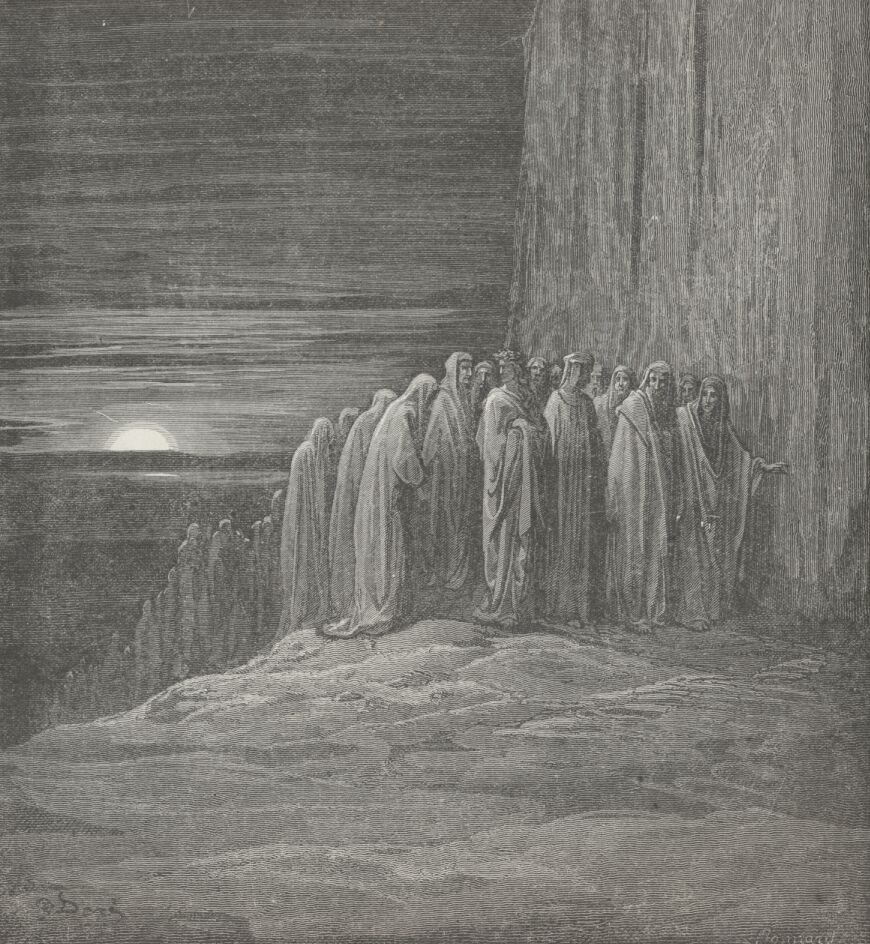
Blawg Review #35, the engravings which accompanied each of the sections of this week's issue are by Gustave Doré and are from the illustrated edition of
The Divine Comedy published in the 19th Century. A larger version of each image is available by clicking on the image. The
complete illustrated edition (translated by Henry Francis Cary) and
Henry Wadsworth Longfellow's Translation (not illustrated), from which I quoted, are both available online through
Project Gutenberg.
My thanks are gratefully offered to the Anonymous Editor for this opportunity to host
Blawg Review for a second time. Thank you also to the many virtuous souls who suggested links for this post.
Blawg Review has information about next week's host and instructions how to get your blawg posts reviewed in upcoming issues.